

CONTEXT
PROBLEM
RESEARCH
PROCESS
SOLUTION
IMPACT
REFLECTION
CONTEXT
Building the steps to onboarding workers
MY ROLE
Senior Product Designer
TEAM
Product Manager, Design Lead, Tech Lead, QA
TOOLS
Figma, User-Interviews, Questionnaires, Hotjar
Flex is the worker-facing app within the Jitjatjo ecosystem, used by gig workers to apply, onboard, and manage their shifts. Onboarding is a critical moment in the worker lifecycle, it must feel simple, trustworthy, and motivating while ensuring applicants meet Jitjatjo’s high operational standards.
My Role: As Senior Designer, the work involved close collaboration with the Design Lead, Product Manager, developers, and stakeholders, with continuous input gathered from real applicants completing the onboarding journey.
CONTEXT
PROBLEM
RESEARCH
PROCESS
SOLUTION
IMPACT
REFLECTION
PROBLEM
A difficult balance of accurate information and time to create
The onboarding flow needed to strike the right balance between speed and assurance. Workers wanted to complete the process quickly, but the business required detailed information, validations, and compliance checks to qualify applicants. The existing flow risked user drop-off due to the number of steps, unclear progression, and reliance on external tools that didn’t always feel cohesive.
Key challenges included:
Preventing abandonment by structuring the journey clearly.
Gathering sufficient capability and accreditation data without overwhelming users.
Ensuring applicants could pause and resume seamlessly.
CONTEXT
PROBLEM
RESEARCH
PROCESS
SOLUTION
IMPACT
REFLECTION
RESEARCH & INSIGHTS
Research focused on understanding the behaviour and needs of real applicants. This included observing early onboarding usage, reviewing Intercom feedback, and speaking with internal teams responsible for recruitment and vetting. Customer service feedback showed that when or if a potential applicant stopped applying, they would need to reach out to them directly to continue the application process, insights highlighted that users responded best to a guided sequence, clear expectations, and progress visibility.
Notable findings:
A structured step-by-step model reduced cognitive load.
Integrations (e.g., scheduling or document checks) needed to feel native.
Workers often completed onboarding in multiple sessions, so continuity was essential.
CONTEXT
PROBLEM
RESEARCH
PROCESS
SOLUTION
IMPACT
REFLECTION
PROCESS
Lean, iterative approach
The design process sought to get something in front of users quickly and adapt along the way. This meant being flexible and agile in our design and a ‘move fast towards an end result’ approach.

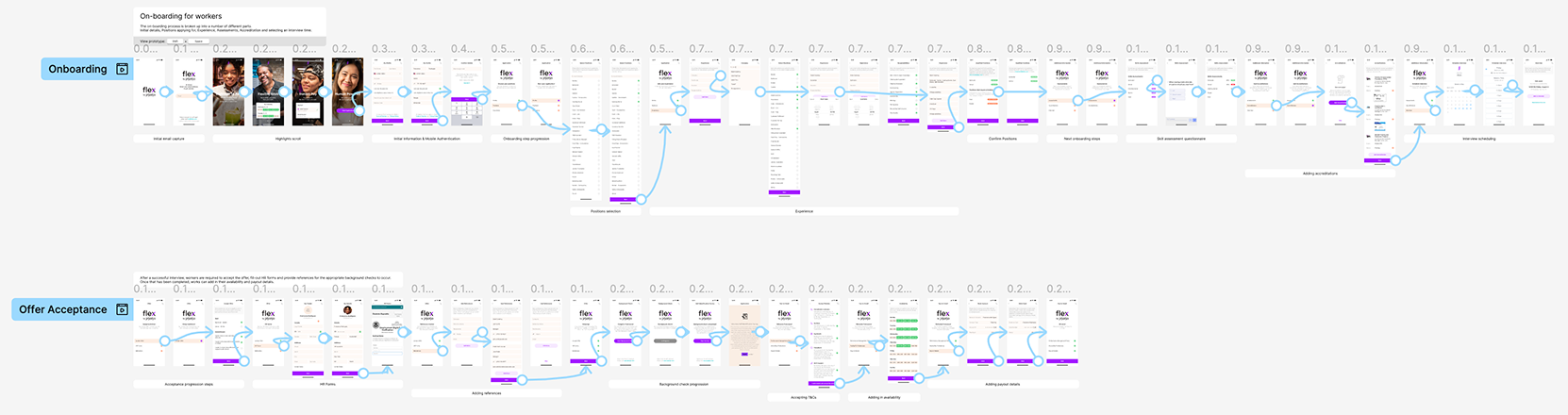
The design process followed an iterative cycle of prototyping, testing, and refinement. Early user flows mapped the entire onboarding journey and identified natural groupings of tasks, which were then refined into four major sections:

High-fidelity Figma prototypes were shared with stakeholders and users, allowing rapid validation before development. Special attention was paid to edge cases, such as interrupted sessions or where a user might potentially be blocked or drop off.
1.
Profile
Positions
Experience
2.
Assessments
Accreditation’s
Interview
3.
Accept Offer
HR Forms
Background Check
4.
Policies
Availability
Payout
CONTEXT
PROBLEM
RESEARCH
PROCESS
SOLUTION
IMPACT
REFLECTION
SOLUTION
A modular, guided onboarding experience
The final design introduced a modular, guided onboarding experience with a clear sense of progression. Key elements included:
A step-by-step structure that broke onboarding into manageable sections, giving users clarity and reduced overwhelming them.
Integrated assessments and accreditation uploads, ensuring roles with compliance requirements could be vetted properly.
Embedded third-party tools such as Calendly for interview scheduling, presented in a seamless way that maintained trust.
A resume-later system that allowed users to return to where they left off, supporting real-life interruptions.
The experience balanced design clarity with operational requirements, ensuring both users and internal teams received the information they needed.





Visualising the breakdown of each section
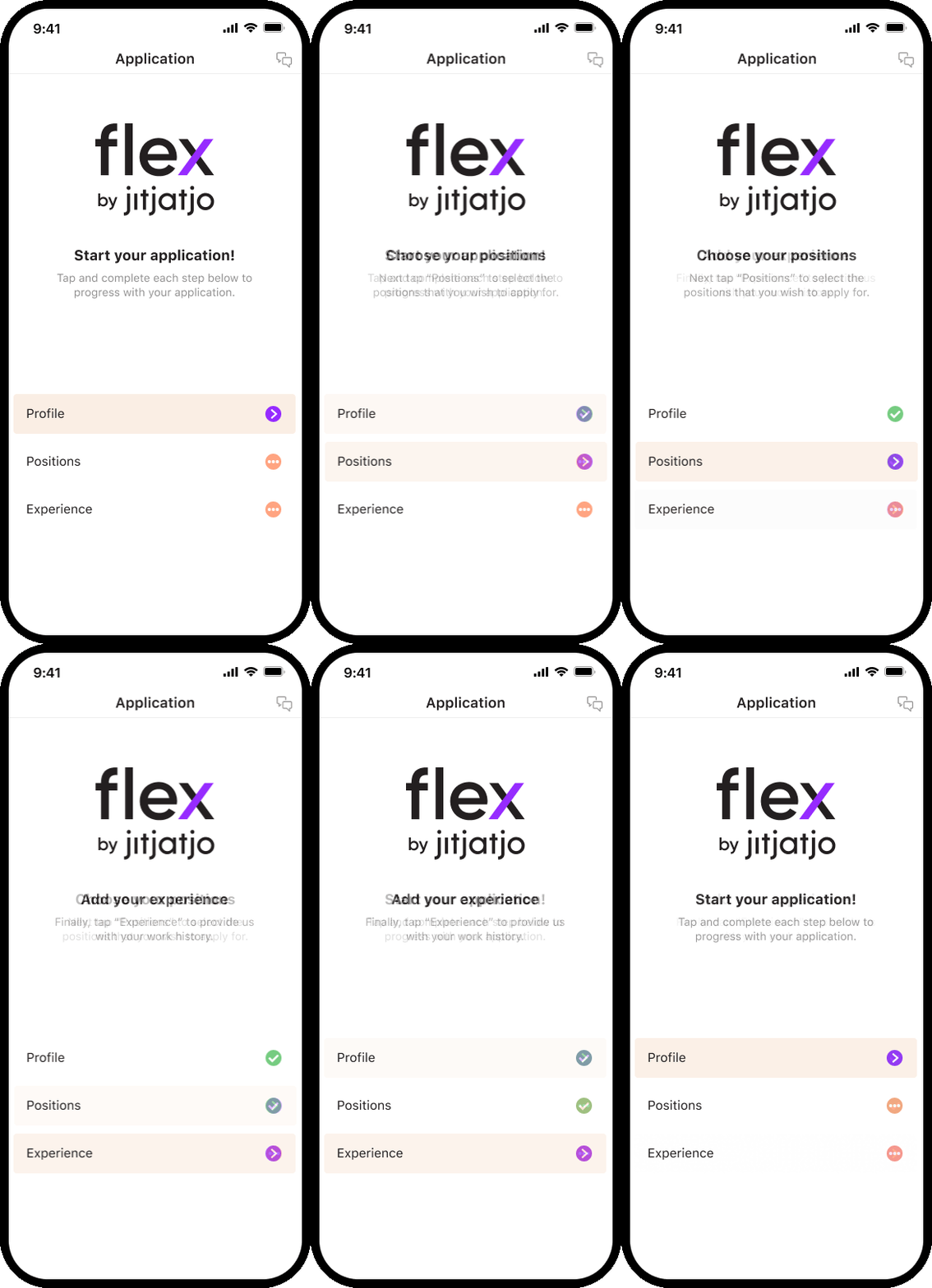
To not overwhelm an applicant, the four separate processes were broken down into three steps respectively. As they made their way through the process, we included visual feedback to show that progress was being made.
Various levels of safeguards
The different levels of safeguards that happened along the way, some more simple than others, such as having certain positions that required experience to be added so an admin could later review and approve.
Various skill assessments quizzes that were mandatory to complete based on their chosen positions.
The ability to add any accreditation’s that may be specific for certain roles, this would allow for increase chances to be booked on gigs that these accreditation’s were mandatory to accept.

3rd party tool integration
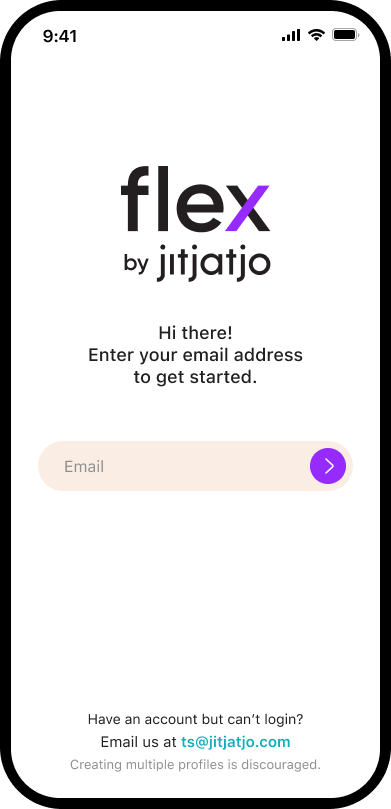
To keep the process entirely within the app, we were able to include third party tools such as calendly.com in order to schedule interviews. Direct HR W2 form integration once accepted. Background check progression and a Voluntary Self Identification Online Survey to be completed.

Choose schedule
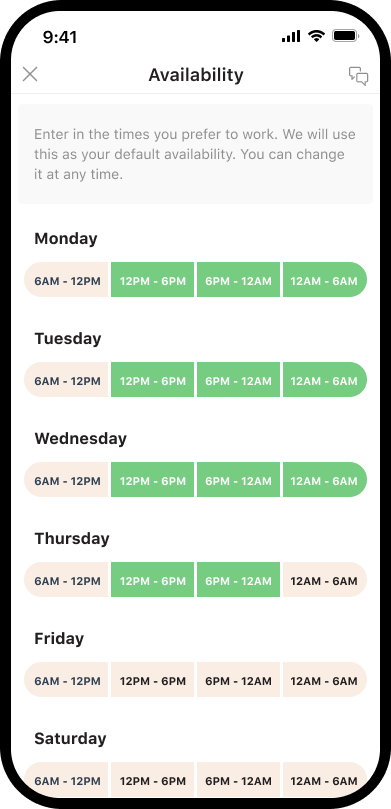
One of the primary factors that motivated workers to sign up for the platform was the opportunity to select their desired working hours. Therefore, the implementation of a straightforward tap-on feature proved to be highly effective in meeting this need.

CONTEXT
PROBLEM
RESEARCH
PROCESS
SOLUTION
IMPACT
REFLECTION
IMPACT
The improved onboarding flow resulted in a smoother, more intuitive experience that reduced early drop-off and increased completion rates. The clarity of the journey helped build user trust, and the structured information collection strengthened Jitjatjo’s ability to qualify applicants effectively.
Customer service intervention dramatically reduced supporting the decisions that the design solutions were the correct ideas to impelment.
Overall, the redesign enhanced both applicant readiness and platform reliability, supporting ongoing workforce growth.
CONTEXT
PROBLEM
RESEARCH
PROCESS
SOLUTION
IMPACT
REFLECTION
REFLECTION
The project reinforced how important it is to design for both user psychology and operational constraints. Creating a flow that felt simple, despite its complexity — required careful hierarchy, visual clarity, and constant feedback loops.
The biggest takeaway was that modular onboarding, clear progression, and flexibility to interruptions are crucial in gig-economy contexts, where users’ time and attention are fragmented. The outcome successfully balanced business, compliance, and user needs within one cohesive experience.